Overland Umrah decision: the policy must come from a licensed Lebanese insurer backed by reinsurance
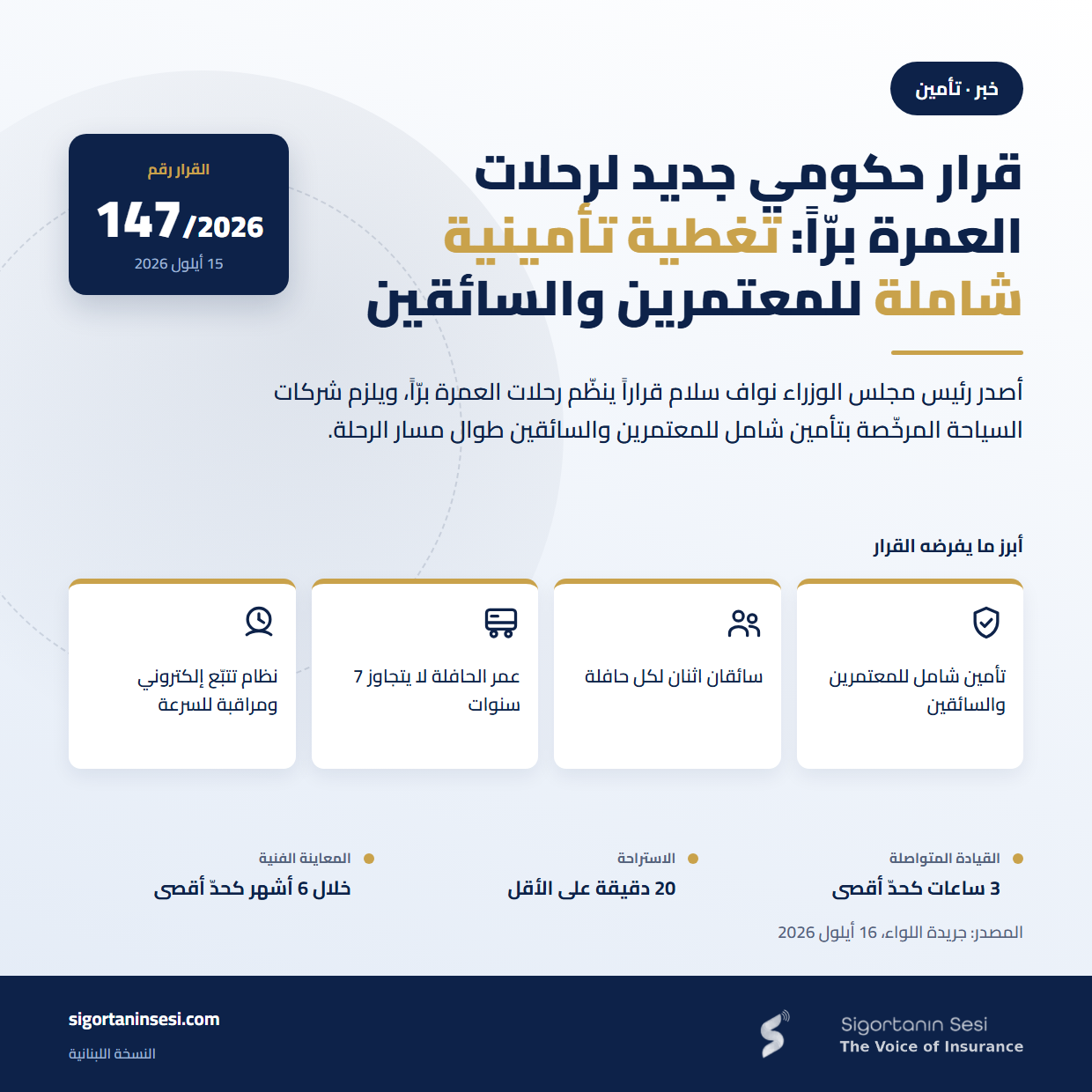
Prime Minister Nawaf Salam's decision No. 147/2026 regulates overland Umrah trips. It obliges the trip organiser to arrange health and accident cover across four countries and to hand each pilgrim the coverage limits in writing. It takes effect on 1 January 2027.
Lebanon's prime minister, Nawaf Salam, has issued decision No. 147/2026 on Umrah trips organised by road. The decision was reported on 15 September 2026 and will enter into force on 1 January 2027.
Its stated rationale is the rise in accidents during overland Umrah journeys and the casualties and injuries they cause. The text was prepared on the proposal of the head of the Authority for the Care of Hajj and Umrah Affairs and after consulting the State Consultative Council.
The decision confines the organisation of overland Umrah trips to tourism companies duly licensed by the Ministry of Tourism. Unlicensed persons and bodies are barred from organising such trips.
The insurance article imposes two separate covers on the organiser: health insurance and insurance against accidents. The contract must be concluded with a company licensed in Lebanon and backed by reinsurance.
The scope of cover is also defined. The policy must cover all pilgrims and the drivers, and must run throughout the journey and the transit, from the departure of the coach to arrival, outward and return. Geographically it must cover Lebanon, Syria, Jordan and Saudi Arabia.
According to the text reported in the press, the cover extends to treatment, hospitalisation and emergencies, as well as injury, death and total or partial disability.
The decision also regulates what happens after a loss. In the event of an accident, the duty to pursue the administrative, legal and judicial procedures with the insurer falls on the organiser. Where necessary, the organiser must appoint a lawyer at its own expense to recover the rights of those harmed, and must inform the Authority for the Care of Hajj and Umrah Affairs of the steps taken.
A further provision concerns informing the traveller. The organiser must hand each pilgrim a written document setting out the conditions and specifications of the trip together with the coverage limits undertaken by the insurer, accompanied by the payment receipt.
Among the non-insurance conditions are that the coach may not be more than seven years old, that it must have undergone an official mechanical and technical inspection no older than six months, that each coach must have at least two legally registered drivers swapping at most every three hours, that continuous driving beyond three hours is prohibited and that a rest stop of at least thirty minutes must follow.
Coaches must also carry a movement-tracking and speed-monitoring system linked to a joint operations room, an advanced first-aid kit and a serviceable fire extinguisher. The organiser must undertake to provide a replacement coach as quickly as possible in the event of a mechanical breakdown, and a health supervisor or licensed nurse must accompany the convoy once it reaches two coaches.
Breach of the decision exposes the organising company to administrative and judicial liability.