Mapfre Re: The real test of a partnership comes after a major loss
Why does Mapfre Re not see Türkiye as "just a high-risk earthquake market"? According to Meyerhoff, what is one of the most important issues for the Turkish insurance sector? The answers are in the interview.
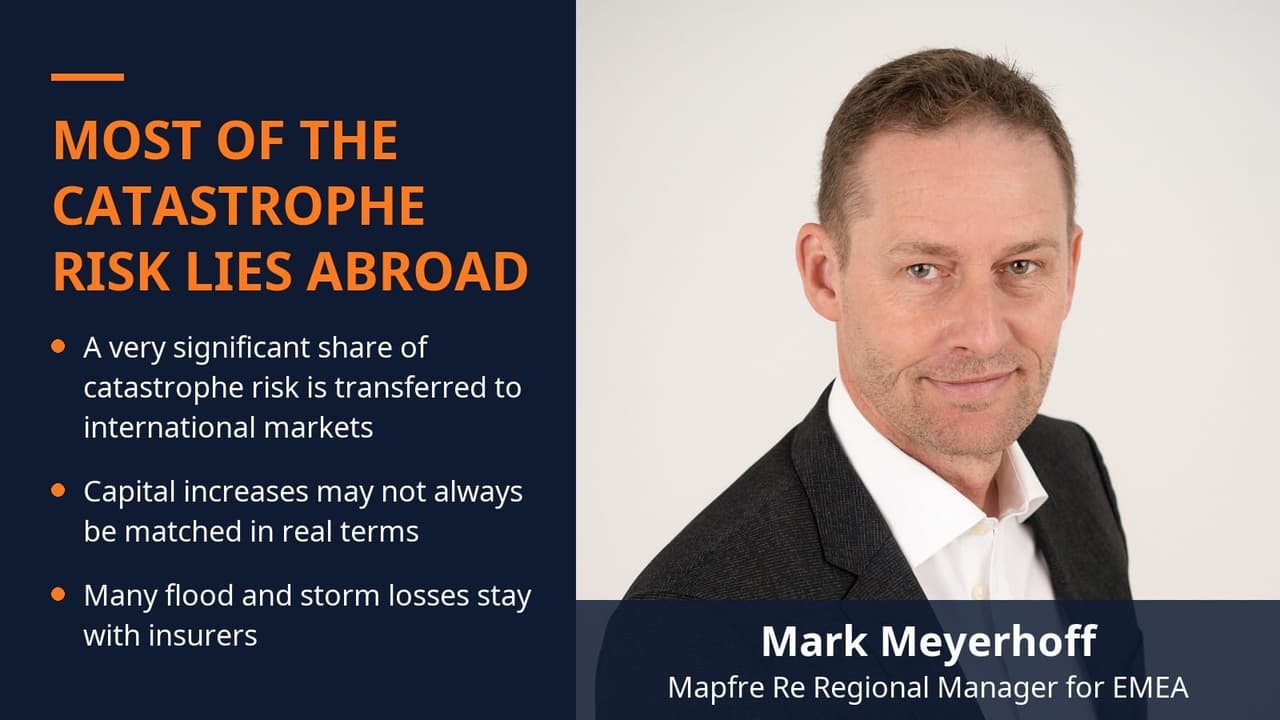
Mark Meyerhoff, Mapfre Re Regional Manager for EMEA, answered Sigortanın Sesi's questions ahead of the 1 January 2027 renewals.
In this part of our reinsurance series, we put six questions to Mark Meyerhoff, Mapfre Re Regional Manager for EMEA. For the readers of Sigortanın Sesi (The Voice of Insurance), Meyerhoff answered our questions ranging from Türkiye's earthquake risk to flood and storm losses, from the impact of high inflation on insurers to the key dynamics of long-term partnerships with international reinsurers.
Sigortanın Sesi: How do you see the 1 January 2027 renewal shaping up across EMEA in terms of pricing, capacity and terms?
Mark Meyerhoff: We approach the 1 January 2027 EMEA renewals at a time when the reinsurance industry is well capitalised. Strong earnings have been retained and added to capital, while the industry has relatively limited opportunities to deploy this additional capital through organic growth. This naturally increases competition and puts pressure on prices.
The more interesting discussion is perhaps how insurers use this environment. In some markets, rather than simply retaining the savings, clients are considering investing part of them in additional protection, either at the top or at the lower end of their reinsurance programmes.
Beyond pricing, I expect a relatively stable renewal in terms of structures and conditions. Individual markets will have their own specific dynamics, but overall, I do not expect fundamental changes.
Sigortanın Sesi: Türkiye is one of the most earthquake-exposed markets in the region. How does Mapfre Re view Turkish catastrophe risk, and what would make the market more attractive for reinsurance capacity?
Mark Meyerhoff: Türkiye clearly has a significantly higher earthquake exposure than most European insurance markets. At the same time, compared with other earthquake-exposed countries, Türkiye is relatively advanced in having established a compulsory earthquake insurance mechanism through TCIP which has significantly improved insurance penetration, increased public awareness of seismic risk, and strengthened the financial resilience of households against catastrophic earthquake losses. This provides an important foundation for managing and financing earthquake risk.
One particular characteristic of the Turkish market, however, is that a very significant share of catastrophe risk is transferred to the international financial and reinsurance markets. This creates a degree of dependency on global capacity and makes the long-term commitment of international reinsurers particularly important.
However, there is also a very important positive message from 2023. Türkiye demonstrated that its insurance and reinsurance system could pay back a very significant earthquake loss within a relatively short period of time. The ability to absorb and settle a major catastrophe loss promptly, and then continue purchasing adequate protection, is a defining characteristic of a large and important catastrophe insurance market.
Ultimately, this is what makes major catastrophe markets attractive, whether we look at Türkiye, Japan, the United States or the major European markets. Reinsurers need confidence that after a major event, the market can recover, adapt and continue to purchase sustainable protection.
At Mapfre Re, we have a long-standing understanding of Turkish catastrophe risk. We therefore see Türkiye not simply as a high-risk earthquake market, but as an important catastrophe market in which long-term relationships, adequate pricing and structures, and a clear understanding of the underlying exposure are essential.
Sigortanın Sesi: Secondary perils such as floods and storms are becoming more frequent in our region. How is this changing the way reinsurers price and structure property programmes?
Mark Meyerhoff: Climate change is certainly having an impact across the region, and we are seeing increasing attention on perils such as flash floods, hail and severe storms, including Türkiye.
From a reinsurance perspective, however, we need to differentiate between the impact on insurers and the impact on reinsurers. In Türkiye, many of these events remain within insurers’ retention levels and therefore do not or do not significantly affect catastrophe reinsurance programmes. Nevertheless, if we were to aggregate the flood losses retained by Turkish insurers over several years, the total amount would probably be significant.
This is somewhat different from parts of Europe, where secondary perils have increasingly become a frequency issue and have generated substantial losses in the lower layers of catastrophe programmes. This is one of the reasons why retention levels in many European markets are significantly higher.
In Türkiye, catastrophe programmes have historically been designed primarily around earthquake risk. Consequently, secondary perils have not played the same role in determining programme structures and pricing.
Looking forward, this distinction is important. If secondary perils increasingly begin to affect reinsurance programmes in Türkiye, reinsurers will need to reflect that additional exposure in both the structure and the price of the protection.
Sigortanın Sesi: High inflation has been a defining feature of the Turkish market. How do reinsurers approach markets with high inflation and currency volatility?
Mark Meyerhoff: High inflation or currency volatility does not mean that reinsurers are unwilling to provide capacity. Reinsurers operate in many markets with challenging economic environments. The key issue is to understand how inflation ultimately translates into exposures, claims and capital requirements.
For reinsurers, high inflation creates several challenges. Insured values and claims costs can increase rapidly, while exchange-rate movements can significantly change exposures when measured in international currencies.
Türkiye is somewhat more complex because inflation, interest rates and exchange rates are closely interconnected. Inflation also remains very high by international standards.
In my view, a major challenge for Turkish insurers is capital. Even when insurers increase their capital in nominal terms, high inflation can make it difficult to strengthen their capital and solvency positions in real economic terms. This is important for reinsurers because we consider not only individual programmes, but also the financial strength and resilience of our clients.
Sigortanın Sesi: Which lines of business do you see as the main growth opportunities in EMEA over the next two to three years?
Mark Meyerhoff: We should first distinguish between growth in insurance and growth in reinsurance, because the two do not necessarily develop at the same pace. Health insurance, for example, is growing strongly in several EMEA markets, but this does not automatically translate into equivalent reinsurance growth, as the need for reinsurance protection remains relatively limited.
From a reinsurance perspective, in Mapfre Re we see a clear growth opportunity in property and natural catastrophe business. The protection gap for natural perils remains significant in many countries. At the same time, new or expanded mandatory catastrophe insurance schemes, together with increasing insured values and greater awareness of natural catastrophe exposures, should generate additional demand for reinsurance capacity.
We also see attractive opportunities in areas linked to the transformation of our economies. Cyber continues to grow as digitalisation increases exposures. Renewable energy is expanding as investment in the energy transition continues, while the rapid development of data centres is creating large concentrations of increasingly valuable and business-critical assets. Surety (re-)insurance should also benefit from investment in infrastructure, energy and major construction projects.
For Mapfre Re, our strategy is therefore not simply to pursue growth wherever the market is expanding. We want to grow selectively in areas where we understand the underlying risks, can establish sustainable pricing and, above all, can support our clients over the long term.
Sigortanın Sesi: What would be your advice to Turkish insurers that want to build long-term partnerships with international reinsurers?
Mark Meyerhoff: For me, the basis of a long-term reinsurance partnership is predictability. An insurer should know where its reinsurer stands, not only during a normal renewal negotiation, but also after a major loss and in both soft and hard market conditions. Equally, a reinsurer needs to understand how its client will behave through these different phases of the market cycle.
Building this kind of relationship requires transparency and consistency from both sides. Insurers should provide a clear view of their portfolios, exposures and underwriting strategy, supported by high-quality data and realistic insured values. This is particularly important in a market such as Türkiye, where catastrophe exposure and inflation materially change the risk over time.
I would also encourage continuous dialogue throughout the year rather than concentrating the relationship around the renewal. This allows both sides to discuss changes in the portfolio, emerging risks and future capacity requirements well before renewal negotiations begin.
Ultimately, a strong reinsurance relationship should not be driven exclusively by the lowest available price. The real test of a partnership is how both parties behave when conditions become more difficult, particularly after a major loss. That consistency builds trust, and trust is the basis of a sustainable long-term relationship.
Today's insurance news in your inbox every evening
On days when new stories are published on the site, one email at 18:00 Turkey time. Unsubscribe at any time.