Lebanon's Markets and the Insurers' Balance Sheet: A Portfolio Built on Distressed Paper
Lebanon's insurance sector is growing in nominal terms while the financial markets that carry its reserves remain distressed. Both statements are true at the same time, and that is precisely why the sector's investment side deserves closer reading. #SigortaninSesi #Lebanon
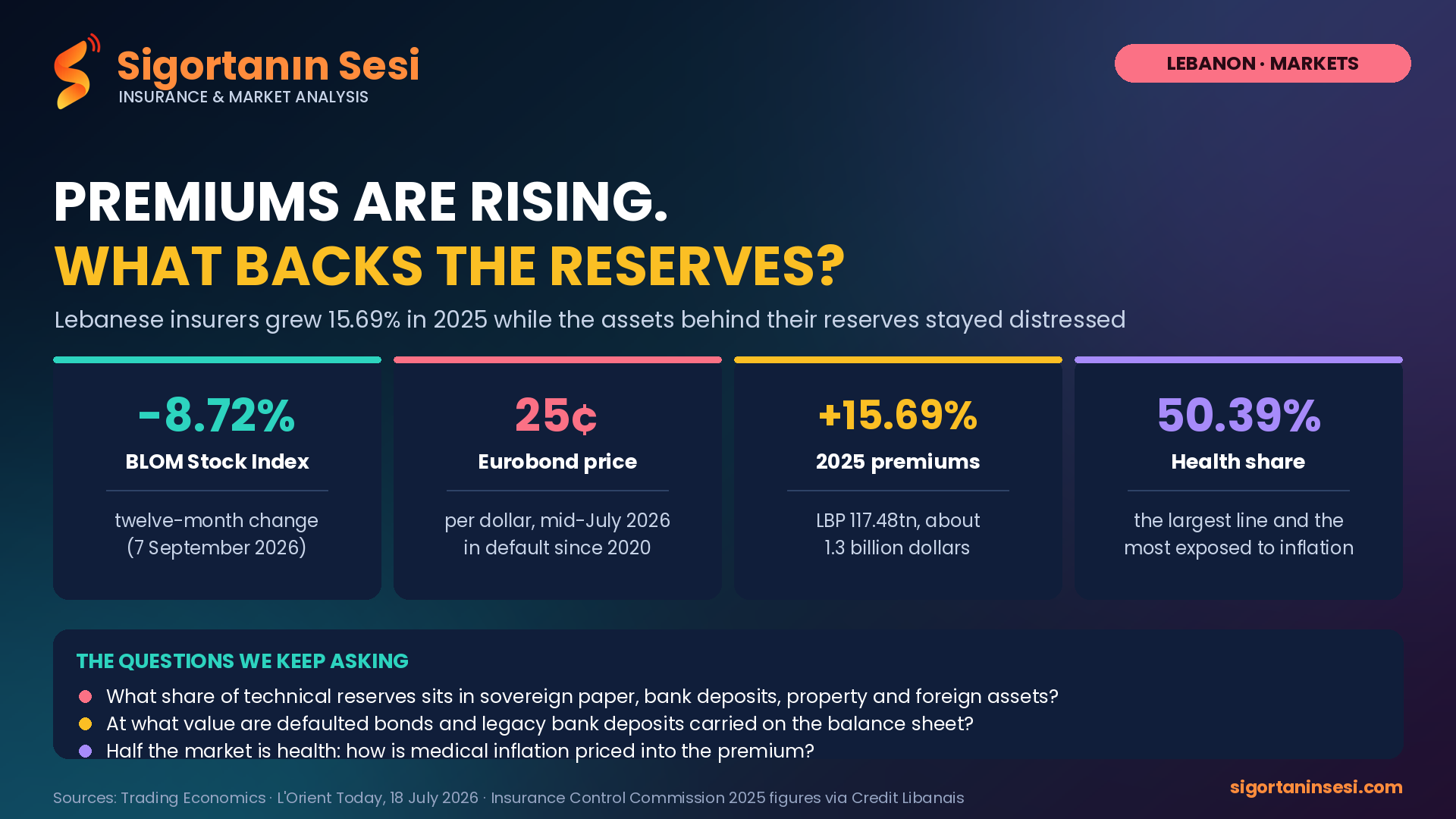
THE MARKET PICTURE The BLOM Stock Index stood at 1,715 points in early September 2026, up 0.60 percent on the day but down 8.72 percent over twelve months.
Lebanese sovereign Eurobonds, in default since March 2020, were trading at around 25 cents on the dollar in mid-July 2026, according to L'Orient Today. Prices had approached 30 cents in late February before falling back after hostilities resumed in early March. Market participants quoted in that report attributed the resilience of prices to bets on a peace breakthrough and a restart of reforms rather than to any completed restructuring.
In other words, the two asset classes available at home — listed equities and sovereign paper — are either flat to negative or priced for a restructuring that has not happened. #Eurobonds
THE SECTOR PICTURE Figures from the Insurance Control Commission, published in March 2026, show gross written premiums of LBP 117.48 trillion in 2025, up 15.69 percent from LBP 101.55 trillion in 2024. At the prevailing exchange rate that is roughly 1.3 billion dollars.
Non-life business accounted for LBP 107.59 trillion and life for LBP 9.90 trillion. By line, health represented 50.39 percent of the market, motor 21.34 percent, property and casualty 19.85 percent and life 8.42 percent.
Paid benefits reached LBP 69.42 trillion, against LBP 62.27 trillion a year earlier. Net investment income came in at LBP 10.95 trillion, a rise of 24.04 percent year on year.
WHERE THE TWO PICTURES MEET An insurer's promise is only as strong as the assets standing behind its technical reserves. In a market where the sovereign is in default and the equity index is negative over twelve months, the composition of those assets is not a technical footnote. It is the core question.
Three questions follow, and they are the ones Sigortanın Sesi will keep asking:
- What share of technical reserves sits in Lebanese sovereign paper, in bank deposits, in real estate and in foreign assets? Is that breakdown published in a form the policyholder can read? - At what value are legacy bank deposits and defaulted sovereign bonds carried on the balance sheet? A reserve is only a reserve at the price at which it can actually be realised. - Health insurance is half the market and the line most exposed to medical inflation. How is that inflation being priced, and what happens to the policyholder when claims costs outrun premium income?
A premium figure rising 15.69 percent in a high-inflation environment says less about the sector's health than the asset side of the balance sheet does. Growth measured in a depreciating currency can mask a shrinking real book.
WHY IT MATTERS FOR THE POLICYHOLDER None of this is an accusation against any company. It is a reminder of how insurance works: the claim is paid out of invested reserves, and the quality of those reserves is decided long before the loss occurs.
For a market recovering from a banking collapse, the most valuable disclosure an insurer can offer is not a growth rate. It is a clear statement of what the reserves are invested in and at what value they are carried. That is the disclosure we would like to see become standard practice in Lebanon. #Insurance #Solvency