Beirut Hosts First Lebanese-Syrian Investment Forum: "Make That Geography Work for Us"
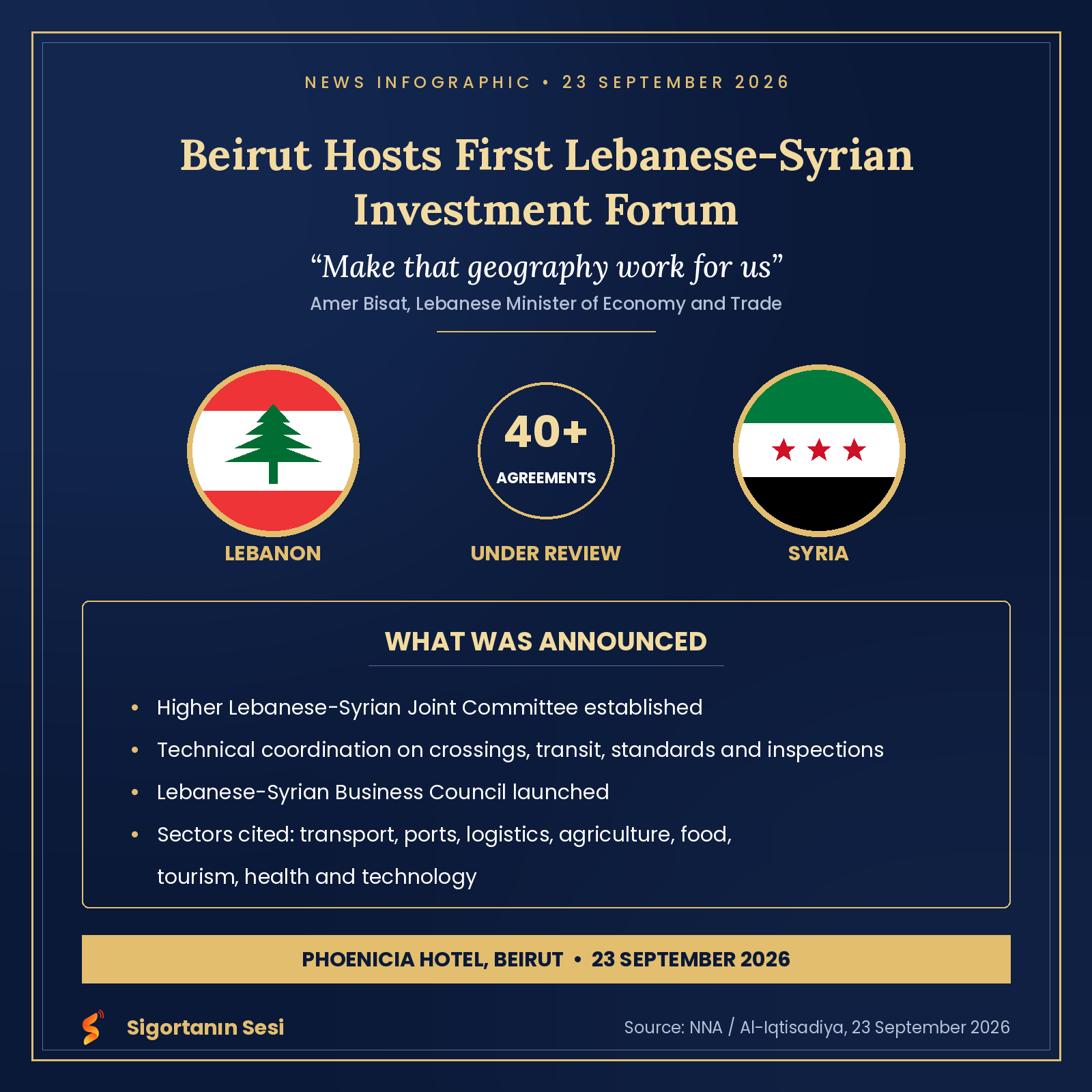
The first Lebanese-Syrian Investment Forum opened on Wednesday morning at the Phoenicia Hotel in Beirut under the patronage of Lebanese President Joseph Aoun, who was represented by Minister of Economy and Trade Amer Bisat. The forum brought together ministers from both countries, business associations, investment agencies and private-sector representatives. #SigortaninSesi #Lebanon #Syria
A BROAD GOVERNMENT TURNOUT Lebanese participants included Information Minister Paul Morcos, Tourism Minister Laura Lahoud, Public Works and Transport Minister Fayez Rasamny, Agriculture Minister Nizar Hani, Industry Minister Joe Issa El Khoury and Minister of Technology and Artificial Intelligence Kamal Shehadi.
The Syrian delegation included Minister of Economy and Industry Mohammad Nidal al-Shaar, Agriculture Minister Basel Suwaidan, Health Minister Musab Nazzal al-Ali, Tourism Minister Mazen al-Salhani and Transport Minister Yaarub Badr. Al-Shaar said it was the largest Syrian government delegation to travel to Lebanon since the fall of the previous government.
Also present were the head of Lebanon's Economic Bodies, former minister Mohammad Choucair; the president of the Syrian Federation of Chambers of Industry, Mazen Dirwan; the head of the Lebanese Investors Association, Jacques Sarraf; the head of the Syrian Investment Authority, Rawad Ramadan; the chairman of Lebanon's Investment Development Authority (IDAL), Majed Mneimneh; and the president of the Syrian-Lebanese Business Council, Leila al-Samman.
FROM INTENTIONS TO INSTITUTIONS Delivering President Aoun's message, Bisat set out three priorities.
The first was institutional. Bisat said a Higher Lebanese-Syrian Joint Committee has been established, headed on the Lebanese side by the prime minister and on the Syrian side by Foreign Minister Asaad al-Shaibani. More than 40 agreements and protocols between the two countries are under review, he said. Technical coordination mechanisms have also been created between ministries, he added, on issues that directly affect the flow of trade: border crossings, truck movement, transit, standards and inspections, trade restrictions, transport and business travel. A Lebanese-Syrian Business Council has been launched to connect the two private sectors directly.
"In the past, our relationship often bypassed institutions. Our new relationship must be made stronger by institutions," Bisat said.
His second priority was a shift from solving problems to creating opportunities. Bisat argued that the ambition should go beyond increasing exports and imports, and asked what the two countries could produce together, which sectors they could invest in jointly and how they could reach regional and global markets.
He linked that shift to changes in global trade: the pandemic exposed the fragility of long supply chains, tariffs and trade disputes pushed companies to diversify routes, and disruption in regional maritime corridors raised shipping costs and renewed the importance of overland routes. Ports in both countries, he said, can become gateways linking the Mediterranean to inland roads, rail lines and energy transmission networks.
His third priority concerned responsibilities. Governments, Bisat said, must remove obstacles, simplify procedures, reduce trade costs, provide a clear and stable legal framework and guarantee fair competition and investor rights, while the private sector identifies opportunities, builds partnerships, mobilizes finance and creates jobs.
"Geography brought our two countries together. Our responsibility today is to make that geography work for us," he said.
SYRIA: "CLEAR AND BALANCED FOUNDATIONS" Syrian Economy and Industry Minister Mohammad Nidal al-Shaar said the forum was an opportunity to move from a relationship imposed by geography to a partnership based on political will and shared interests. That partnership, he said, must rest on clear and balanced foundations, with full respect for the sovereignty of both countries.
Geographic proximity alone does not create economic integration, al-Shaar said; integration requires clear rules, credible institutions, functioning crossings, banks that finance trade, companies that invest and capital able to price risk.
He said Lebanon has strengths in services, business, education, health and entrepreneurship along with an extensive diaspora business network, while Syria has a large market, a production base that can expand in agriculture and industry, and a location that serves as a land bridge to regional markets. Joint value chains, he added, are possible in transport, ports, logistics, agriculture, food industries, tourism, health and technology.
Al-Shaar said Syria's new economic model rests on a free economy, competition and private-sector partnership, with the state acting as regulator and enabler rather than as a competitor to investors. Work is under way on the legislative and institutional environment, financial and banking reform, governance, transparency and compliance, he said.
"A Syria that is economically strong is in Lebanon's interest, and a stable and prosperous Lebanon is in Syria's interest," he said, calling for a new economic relationship rather than a return to the old one.
A FORUM MEANT TO CONTINUE Ahmad Hachimiyeh, who launched the forum initiative, said the meeting was not just another conference but the start of an economic track intended to move from ideas to partnerships, investments and projects. He said every session carried the names of both countries. The sessions covered Lebanon and Syria in the new economic map of the Middle East; financing the economy of the future; restoring confidence, reconstruction and sustainable development; and the development of transport, ports and links to regional markets.
Syrian Chargé d'Affaires in Lebanon Iyad al-Hazzaa said the region had reached a point where it must move from crisis management to creating opportunities, and described the investment partnership between the two countries as a necessity rather than an experiment.
WHY IT MATTERS For the insurance and logistics sectors, the practical content of this forum lies in a single line of the agenda: crossings, truck movement, transit, standards and inspections. Every item on that list is also an insurance question. Cross-border transport volumes, cargo coverage, transit guarantees and the ability of local insurers to write and settle such risks will follow whatever is agreed at the technical level.
Sigortanın Sesi will continue to follow the review of the more than 40 bilateral agreements and the work of the newly launched Lebanese-Syrian Business Council. #Insurance #Trade #Investment